Table of Contents
Troll
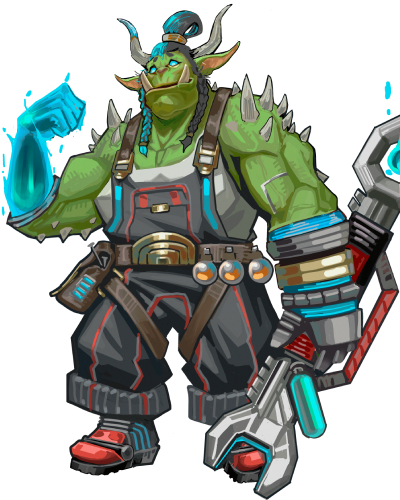
Trolls, also known as Goyls, Slabs, Tollers, Greenskins or Faefolk, are a towering, upright people defined by mass, resilience, mysticism and a surprising kindness. They move on two primary lower limbs and manipulate their environment with two upper limbs, though their proportions often favour the upper body: arms are typically longer, thicker, and more powerful than the legs, giving many trolls a forward-weighted silhouette. This varies widely, some individuals appear broadly proportioned and balanced, while others present a distinctly top-heavy frame shaped by leverage and reach. Adult trolls average roughly 320 centimetres in height and approximately 400 kilograms in mass, though both measurements fluctuate significantly with age, environment, and individual growth patterns.
Their outer flesh is dense and resilient, forming thick, layered skin that appears leathery or blubbery to the touch. This surface is rarely smooth. Troll bodies are marked by nodules, ridges, and irregular growths that resemble accumulated scar tissue, even on individuals who have never suffered serious injury. These formations are not wounds but expressions of their regenerative biology and magical resilience, creating the impression of a body that has been rebuilt many times over. Coloration varies, most commonly presenting in greens, mossy yellows, deep reds, and earthen browns, often mottled or uneven rather than uniform.
Their facial structures are broad and heavy, dominated by pronounced jaws lined with sharp, interlocking teeth suited for tearing and crushing. Many trolls develop tusks that protrude from the mouth, curving outward or upward in irregular patterns. In addition to tusks, trolls grow horns and keratinous spines across their bodies, most frequently along the head, back, forearms, and shoulders, though smaller growths may appear at joints or along the spine. These protrusions are typically numerous and compact rather than large or branching. Some trolls also grow coarse hair, but horn and spine growth is far more characteristic, often occupying the same regions where other species develop dense hair coverage.
Trolls do not possess biological sexes and exhibit no sexual dimorphism. They are magical beings by origin, reproducing through astral processes that remain poorly understood. Attempts by Federation researchers to observe or document troll reproduction have consistently failed, often due to inexplicable lapses in tracking, memory, or spatial continuity during study, as if the universe simply wouldn't allow the study. While many trolls adopt genders as a social identity after exposure to Federation cultures, these identities are cultural rather than biological. Younger trolls exist, but they do not pass through an infant stage recognizable to most species; instead, newly formed trolls appear closer to an adolescent state, already physically capable and mentally aware.
A defining feature of troll physiology is their relationship with time and stasis. Many trolls experience long cycles of movement and wandering, followed by periods of deep hibernation during which their bodies gradually petrify into stone. These states can last for many Marks or extend across entire Ages, after which the troll may reawaken with body intact and strength undiminished. Combined with their extraordinary regenerative capacity, this renders trolls functionally immortal. Destruction is possible, but uncommon. Far more frequent is “Trolldeath,” a catastrophic injury to the brain that erases memory and identity while leaving body and animating essence intact. In such cases, the being that remains is physically alive, but the individual is irrevocably lost.
Though imposing in stature, trolls are generally sociable and warm, comfortable in company yet equally content with solitude. Lacking traditional family structures, they form bonds slowly but deeply. Their memories—especially for physical spaces, lived experiences, and repeated actions—are exceptionally strong, allowing skills to be retained over immense spans of time. Abstract systems, particularly academic topics or those involving layered social constructs such as economics or statecraft, often prove more challenging. Despite this, trolls are widely regarded as kind, loyal, and emotionally open. When angered, however, they are among the most dangerous individuals in the Federation, combining immense strength with a near-total resistance to harm.
Trolls are are said to have descended from the Fae — spirits of the Astral Space — and share this lineage with elves and gnomes, though their physicality often obscures this connection in the minds of other species. Their bodies sometimes express this heritage directly: patches of bark-like growth, leaf-shaped protrusions, or mineralized textures may appear along the limbs or torso. This intrinsic magical nature, coupled with a culture guided more by fate than hierarchy, allowed trolls, despite minimal centralized governance, to construct and donate a D’jumpship to the Federation. Their presence on the High Council stands as quiet proof that simplicity should never be mistaken for smallness.
Culture
Troll culture is shaped by movement rather than settlement. While trolls are capable of deep companionship, traveling together, working together, even remaining in one another’s lives for entire Ages — they are equally defined by long periods of solitude and wandering. This rhythm has left them with little need for rigid social structures or centralized governance. Instead, trolls tend to organize themselves through personal bonds, shared purpose, or temporary alliances that dissolve naturally when paths diverge. Many choose to bind themselves to Federation institutions, corporations, or individual patrons, finding satisfaction in service and reliability, while others remain unaffiliated, drifting between worlds and aiding where instinct or circumstance calls.
This individualism produces a culture that is both spiritually inclined and broadly tolerant. Trolls are slow to judge and quick to accept difference, having spent much of their existence as outsiders moving through the societies of others. When the Rigging Boom transformed much of the Federation — privatizing former state structures and converting representation into corporate power — most races followed suit, willingly or otherwise. Troll representation did not. Their delegates, envoys, and advocates are often the same individuals across centuries, many still employed directly by the Federation or acting as independent agents guided by personal codes rather than institutional mandates. Though major corporations such as Industrial Industries maintain a strong cultural association with trolls, this reflects the species of their founders and early workers, not the absorption of a former troll government.
Troll history prior to Federation contact is fragmented and largely oral, but persistent stories suggest their original homeworld was so hostile that they abandoned it not through technology, but through astral rituals and migration. Long before ships or star charts, trolls wandered outward, world by world, until settling on Mörkskogen in the Funnenhem system, which they now consider home. Whether born of necessity or temperament, this wandering nature appears to have minimized large-scale conflict among trolls. While early eras saw duels and localized struggles for leadership, these conflicts were personal or communal rather than civilizational. Punishment for serious wrongdoing traditionally took the form of exile, based on the belief that isolation would eventually lead to Trolldeath, cleansing memory and guilt alike and allowing the body to continue as a new being, unburdened by past harm.
Though trolls joined the Federation officially many Epochs after its founding, their presence predates formal recognition by vast margins. Trolls appear in Federation records, myths, and first-hand accounts from the earliest eras, always as wanderers, helpers, or silent witnesses. Their ability to endure extreme environments, navigate unfamiliar spaces, and grasp magic through instinct rather than study has made them invaluable allies. To many historians, they believe trolls have always been there — walking between the stars long before most civilizations learned how to follow and will be there long after the lights in the sky die out.
Role in the Federation
Trolls have been present in Federation space since its earliest eras, long before formal membership or recorded treaties. Their innate tendency to appear in places, often with no clear recollection of the specifics of the journey — meant that trolls surfaced across developing civilizations as helpers, laborers, guardians, or quiet observers. Early Federation records contain numerous unexplained references to large, resilient individuals assisting in disasters or frontier construction centuries before trolls were formally identified as a people. By the time the Federation learned to catalogue them, trolls had already woven themselves into its history.
The first defining conflict involving the troll peoples occurred during the early settlement of Mörkskogen, a harsh yet fertile world later designated their home. Initially classified by Elven and Atlantean explorers as a high-risk mega-fauna planet — inhabited by massive predatory reptiles and hostile magical lifeforms — it was deemed unsuitable for most species but viable for trolls. The Federation offered the world to the homeless troll population, unaware that another displaced race, the Yötuns, had also set their hopes upon it. Refusing Federation affiliation, the Yötuns rejected the ruling and invaded Mörkskogen to claim it by force. The resulting multi-Mark war, remembered as the Mörkskogen Massacre, stands among the bloodiest conflicts ever recorded, defined by catastrophic physical clashes and overwhelming magical force on both sides. Though victorious, the trolls emerged deeply scarred by the conflict, while the Yötuns, already weakened from a previous war with the orcish peoples, never fully recovered. They would later join the Federation, but their numbers continue to decline across the Ages.
In the long aftermath, trolls became indispensable to Federation expansion. During the Rigging Boom and subsequent waves of colonization, they proved uniquely capable of establishing footholds on worlds deemed too hostile for conventional settlement. Their resilience, instinctive grasp of unfamiliar environments, and tolerance for extreme conditions made them ideal pioneers. Troll labour and leadership featured prominently alongside Elven and Atlantean allies, forging deep bonds that persist through shared oaths and long-standing cooperation. Their territories near Mörkskogen also placed them adjacent to Orcish and Human regions of space, drawing them into close diplomatic and economic partnership during later Ages.
Troll relations with the Orcish peoples were not always amicable. When orcs first reached the stars, their expansion was rapid and violent, resisting Federation diplomacy and triggering widespread conflict. The ensuing wars, called the Jade Conflict by Elves and more commonly remembered as the Greenskin Wars, strained Federation forces despite their technological and magical advantages. It was the trolls’ intervention that altered the course of the war. Entering the conflict to protect their home region and defend long-standing allies, trolls served as devastating shock forces, breaking through dense orcish formations, neutralizing critical targets, and, unexpectedly, opening paths to negotiation. The orcs, far from resenting this intervention, found it admirable. Mutual respect followed quickly, leading to an enduring alliance and the orcs’ rapid accession to the Federation.
Rules
Below you will find the unique rules and stats you will need to fill out your character sheet.
Stat Block
Mundane Stats
Perceptions
Unique Abilities
Regeneration
Troll flesh refuses to accept endings. Their bodies regenerate continuously at the cellular level, rebuilding damage faster than most species can process pain. Gunshot wounds close in moments, shattered bones realign and knit within minutes, and even severed limbs are temporary inconveniences rather than lasting losses. Fire, acid, and catastrophic trauma can slow this process, but fully destroying a troll body is extraordinarily difficult. Time itself holds little authority over them, age does not wither or weaken, only reshapes, adding new horns, shedding old growth, and subtly rewriting form without decay. While a sufficiently severe injury to the brain can result in Trolldeath, erasing memory and identity, the body endures regardless. Across the Federation, trolls are not feared because they cannot be killed, but because even when they should be dead, they simply stand back up.
Trait.
At the start of your Turn, you restore Health and heal Injuries as if you had just performed a Rest.
In addition, when you do perform a Rest, you heal Wounds as if they were an
Injury with a Severity of 50.
Miraculous Physiology
Troll bodies are not bound to consistency. As astral-descended beings, their physical form is sustained as much by magic as by matter, allowing them to function in ways that obey natural law, even without a known need. Federation Chop Docs frequently report medicines that fail entirely, or prove outright toxic, only to find those same treatments working perfectly after a few Marks, as though the troll’s body had quietly rewritten itself to accommodate them. Unlike many astral species, trolls remain deeply responsive to their environment, and this adaptability compounds with their immense size and strength. Prolonged exposure to demanding conditions can result in dramatic physical escalation: greater mass, denser muscle, and overwhelming brawn, particularly among warriors and industrial laborers. Troll physiology does not merely endure reality, it negotiates with it, and reality often concedes.
Trait.
You count as having a Organic Physiology as well as an Astral Physiology.
In addition, you only require 3 Exp per Rank, instead of 4, to increase your Brawn.
Too big! You pay extra!
Trolls are enormous, and the universe is not built to accommodate them. Their size grants strength, reach, and undeniable presence, but it also carries constant logistical cost. More mass means greater strain on vehicles, machinery, and infrastructure; a troll often weighs enough to require reinforced transport, specialized seating, or multiple tickets where others need one. Their bulk makes them difficult to miss in a firefight, and their horns complicate something as simple as finding clothing that fits without custom work. Cybernetic augmentation, while possible, must be individually engineered at great expense to account for their scale and physiology. In a galaxy designed for smaller bodies, trolls move through space as living exceptions, powerful, unmistakable, and perpetually aware that are just too damned big.
Trait.
You suffer a 50% price increase on Apparel and a 25% price increase on Cyberware, rounded up.
In addition, when calculating the Total number of [Crew] or [Passengers] on a [Vehicle], you also count as 2. However, you still only require a single [Console].
Furthermore, you may also suffer difficulties, where Appropriate, when traversing doorways, corridors, entering public vehicles and anywhere your size might be an issue. This may include but it not limited to being unable to fit, or using up more space or even suffering the effects of the Disadvantage Property.
Changelog
Version 0.5c - June 2026
- Wordings updated.