Table of Contents
Atlantean
| Attributes | ||
|---|---|---|
 |
||
| Avg Life Span | Varies | |
| Sexual Dimorphism | Typically Yes | |
| Sexes | Typically Male/Female | |
| Physiology | Organic | |
| Average Height | Varies | |
| Average Weight | Varies | |
| Home System/Planet | Achaemedia Prime, Atlantis | |
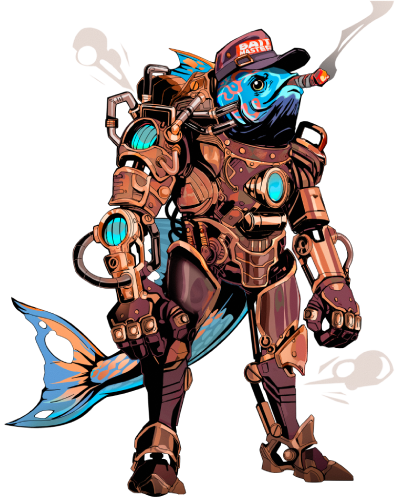
The Atlanteans, also known as Fisho's, Squidies, Divers and Quadies, are not a single people, but a convergence of many. Originating from the complete ocean world of Atlantis, they encompass hundreds of distinct sapient aquatic species, unified not by shared biology but by shared history and identity. Their physical forms vary more wildly than almost any other Federation people: some possess fins, bladders, and sinuous bodies; others bear limbs, tentacles, or elongated forms adapted to pressure and current. Size alone ranges from creatures scarcely longer than a finger to vast beings measured in dozens of metres, their mass spanning from negligible to monumental. What little they share biologically is functional rather than aesthetic, each is fully aquatic, each requires liquid to breathe, and each is most at home suspended in water rather than standing on land.
Despite this diversity, patterns do emerge. Most Atlantean species exhibit sexual dimorphism, typically with two sexes, and in many cases the females are larger or more robust. Their senses are often adapted to lightless depths, pressure gradients, and fluid motion rather than open air, and while some can survive limited exposure to non-liquid environments, none can breathe standard atmospheric mixtures. Movement through water is effortless to them, instinctive in a way that walking is to terrestrial peoples. On land, without assistance, most Atlanteans unable to propel themselves, and rare few who can are often diminished, slowed, constrained, and profoundly out of place.
To most Federation citizens, however, an Atlantean is not first recognised by the body within the water, but by the body that walks among them. The Modular Biosuit, commonly called a Mod-Suit, is the most visible expression of Atlantean presence beyond Atlantis. These pressure-sealed constructs house water, life-support systems, sensory translators, articulated limbs, and typically made of brass composite, allowing their wearers to interact with a universe never designed for them. Though once based on early Elven artificer designs predating the Federation, Mod-Suits have long since become an Atlantean art form. Each is customised, maintained, and often inherited, reflecting the needs, personality, and lineage of its pilot. For many Atlanteans, the suit is not merely a tool, but an extension of self—sometimes spoken of as a second body, sometimes as the true one.
Within Federation space, accommodation for aquatic life is widespread. Liquid conduits, communal fluid chambers, and universal medium pipelines allow Atlanteans to travel without suits if they choose, drifting unseen through infrastructure designed to support many water-bound peoples. Even so, most Atlanteans prefer their Mod-Suits, valuing the ability to stand eye-to-eye with others, to gesture, to eat, and to participate directly in shared spaces. Thus, across stations and worlds alike, the sight is common: towering brass forms moving with careful grace, guided from within by beings as small or strange as the oceans themselves. In this way, the Atlanteans embody a paradigm familiar to the Federation at large. They are endlessly diverse, often alien even to one another, yet bound together by a shared past and a collective decision to stand as one people. As Atlantis itself is a world of many depths, so too are the Atlanteans, a federation within a Federation, held together not by sameness, but by choice.
Culture
Atlantean culture is inseparable from the nature of Atlantis itself, a world of depth layered upon depth, where pressure, darkness, and isolation shaped civilisation long before unity was imaginable. Because sapience arose independently across vastly different strata of the planet, Atlantean society did not begin as a single culture, but as many: peoples separated by kilometres of crushing water, incompatible biologies, and mutually hostile environments. When these cultures first encountered one another, the results were rarely peaceful. Early Atlantean history is defined by cycles of discovery followed by conflict, with entire species erased before others even knew they existed. For many Ages, genocide was not an aberration, but a recurring outcome of contact.
The arrival of the Elven peoples marked a turning point, though not the one the Elves intended. To the Atlanteans, the Elves were something unprecedented: outsiders who could traverse pressure layers with ease, who spoke across cultures, and who possessed tools that rendered ancient environmental boundaries irrelevant. The gifting of early Mod-Suit technology was meant as a bridge, a way to foster communication and shared identity. Instead, it became an accelerant. Long-standing rivalries were suddenly unbound by geography, and conflicts that once took generations now consumed entire peoples in mere Ages. This period remains one of profound cultural trauma for the Atlanteans, not only for the lives lost, but for the knowledge that much of their annihilation was self-inflicted, made possible by borrowed power.
In the aftermath, what survived was not a return to isolation, but a radical rethinking of unity. When the Atlanteans eventually forged a planetary government, it was not based on dominance, but on coexistence, an explicit rejection of biological supremacy in favour of cultural pluralism. Species, lineages, and traditions that remained were preserved not as relics, but as living parts of a broader identity. Difference became something to protect rather than erase. Even today, Atlantean society places extraordinary value on cultural memory, ritual exchange, and the deliberate celebration of variance. To lose a people is to lose an entire way of perceiving the universe, and that loss is considered irreparable.
This history has made Atlanteans deeply committed to the ideals that would later define the Federation. They are not naïve about violence, nor do they pretend conflict can always be avoided, but they are among the most ardent supporters of First Contact Protocols and interspecies governance. These systems mirror the principles that ended their own Age of Bloodshed: slow engagement, mutual recognition, and restraint in the application of power. Where once their world taught them how easily difference could lead to annihilation, modern Atlantean culture teaches the opposite, that survival, at scale, requires cooperation without homogenisation. As a result, Atlanteans are often seen as some of the Federation’s most passionate advocates, not because they believe unity is easy, but because they know exactly how catastrophic its absence can be.
Role in the Federation
Within Federation popular history, the Elven peoples are often described as the first race of the Federation, their language, aesthetics, and early technologies so deeply embedded that it can seem self-evident. Among the Elves themselves, however, a different account endures, one still taught in their academies and remembered as recent history by some lineages, as it was only a mere dozen generations ago for some. In this telling, the Atlanteans were not only present at the Federation’s birth, but were its first true architects. After the Age of Bloodshed ended on Atlantis, the surviving peoples forged a united system of governance to prevent their world from ever again tearing itself apart. When the Elves later joined this structure, it expanded outward, becoming what would be known as the Federation of Sapient Races.
The decision that would change history began with a name. The newly unified Atlanteans, burdened with countless cultures and old grievances, could not agree on what to call their world, as each people had named it differently. Over time, the stories of the Elves — long absent, elevated to myth and divinity, took on a reverent tone. Believing they had driven away gods through their sins, the Atlanteans chose the Elven name Atlantis and resolved to seek the Elves out, not as conquerors or rivals, but as penitents. From this resolve came the first great undertaking of interstellar civilisation. Led by J’Son and a devoted cadre of followers, the Atlanteans began construction of a vast vessel inspired by Mod-Suit principles: a mobile ocean, habitat, and cultural ark capable of sustaining life across the void. Though it lacked what would later be known as D’jump technology, it was nonetheless the first Homeship ever built. Named the Argonaut, it carried its crew into the dark between stars on a journey that would take many Ages—far longer than a single lifetime. None of the original crew would live to see its end, but their descendants would carry their purpose forward.
When the Argonaut finally reached Avalon, it found not benevolent gods but a civilisation in crisis. The Elves, in an attempt to atone for their earlier arrogance toward Atlantis, had sought to halt all outward exploration and upset the balance of their system. In doing so, they incurred the wrath of Ladon, the ancient Dragon Spirit charged with guarding the Golden Apples, the planetary bodies of the Celestia System. They had attempted to bind the Dragon Spirit to their will, to police their space above all others and in his fury, Ladon had bound the Elves into servitude, turning protectors into prisoners. The Atlanteans, raised on struggle and sacrifice, took up arms without hesitation. Though many perished, their intervention allowed the Elves to rise alongside them, and together they broke Ladon’s dominion.
Restored to harmony, Ladon withdrew into the Astral Space, resuming his vigil over the realms. In recompense, he granted the descendants of J’Son the Golden Fleece: an advanced Mod-Suit design that allowed Atlanteans unprecedented freedom beyond water. This gift would become the foundation for all modern Mod-Suits. In the Ages that followed, Elves returned with the Argonaut to Atlantis, and from the alliance forged in blood, regret, and shared resolve arose a new ideal, one that welcomed difference rather than feared it. Thus, Elf and Atlantean together carried the Federation to the stars, offering its promise to all who would join it.
Rules
Below you will find the unique rules and stats you will need to fill out your character sheet.
Stat Block
Mundane Stats
* See Mod-Suit Below **
=== Perceptions ===
^ **Visual ^ Electromagnetic ^ Astral ^ Digital ^ Physical ^ Social ^
| Average | Oblivious | Average | Oblivious | Average | Acute |
Mystical Stats
Miscellaneous Stats
Your [Entity Type] is: [Sapient]
Your Physiology is: Organic
Your Size is: See Mod-Suit Below
Please Note: For information on ranking up Stats see: Ranking Up.
Unique Features
Aquatic
Atlanteans are creatures of liquid environments, fully adapted to life beneath the surface. They breathe and thrive only when immersed in water or compatible fluid mediums, where movement, perception, and bodily function come naturally. Outside such environments, their biology falters quickly, rendering them unable to survive without technological assistance. This limitation is not a weakness so much as a defining truth of Atlantean existence: the depths are their domain, and dry land is not.
Trait.
You do not have the [Terranean] [Movement Type]. You gain the [Liquidic] [Movement Type] instead.
Mod-Suit
The Mod-Suit is the bridge that allows Atlanteans to leave the waters of Atlantis and take part in the wider Meat Space. While some Atlanteans can traverse non-liquid environments with minimal life-support, many lack the limbs or structure needed to meaningfully interact with a dry world, and so the Mod-Suit becomes more than equipment, it becomes body. These suits are deeply personal, worn constantly, customised over many Marks, and treated as an extension of self. Atlanteans decorate them, modify them with cyberware, mark them with insignia and personal art, and dress them as others would flesh. Across Federation space, the sight of a towering brass form moving through a crowd is unmistakable. The Mod-Suit is not merely survival technology; it is the Atlanteans’ physical presence in the universe, and a living symbol of their place within the Federation.
Trait.
Each different type of Atlantean requires a different type of Mod-Suit for mobility and to survive outside of their home planet or other aquatic environments. For some, their Mod-Suit is their home or preferred body, for others it is simply clothing, preferring to spend more time in open water.
An Atlantean's Brawn and Agility varies greatly from species, of which there are thousands that are native to Atlantis. However, these are determined in conjunction with the Mod-Suit. Consult the following table to choose your Starter Brawn and Agility, which in turn will determine your Suit Points.
Choose two packages, from the below. One for your Brawn and another for you Agility.
| Pack | Starter | Maximum | Suit Points | Suit Size | Body Size |
|---|---|---|---|---|---|
| A | 6 | 11 | 0 | 1 | 4 |
| B | 5 | 9 | 2 | 2 | 3 |
| C | 4 | 7 | 4 | 3 | 2 |
| D | 3 | 5 | 6 | 4 | 2 |
| E | 2 | 3 | 8 | 5 | 1 |
| F | 1 | 1 | 10 | 6 | 1 |
Once you have chosen your Brawn and Agility from the above, in addition to determining your Starting Brawn and Agility, this will also determine your Maximum Stats, suit points, suit Size and body Size.
Add your Starter and Maximum Brawn and Agility to your [Character Sheet], as this is the Brawn and Agility you will use when you are not in your Mod-Suit.
Then, add your Suit Points together, as they will be used to determine the Brawn and Agility for your Mod-Suit. Then add your Suit Size, as this will determine your Size when you are in your Mod-Suit. Then, add your Body Size together, as this will determine your Size when you are not in your Mod-Suit.
Now, you may determine your Mod-Suit Brawn and Agility. Your Mod-Suit starts with 0 of each, and you may increase either of those Stats by 1 by spending 1 of your Suit Points until you have none left.
For a Mod-Suit to function as a Mod-Suit, it must have at least 2 Brawn and 2 Agility. If it has less, then you do not have a Mod-Suit and instead you gain an additional [Belt Slot] and a free [Life Support Belt]. In addition, you will also gain the [Terranean] [Movement Type].
Example #1:
If I picked package A. for my Brawn and package B. for my Agility, I would have 6 Starter and (11) Maximum Brawn as well as 5 Starter and (9) Maximum Agility, 2 Suit Points and my Suit Size would be 3, while my Body Size would be 6. Since this would not be enough Suit Points, my Character's Mod-Suit would just be a [Life Support Belt] and thus my Character would have 6 Brawn, 5 Agility</wrap> and 9 Size.
Example #2:
If I picked package E. for my Brawn and package D. for my Agility, I would have 2 Starter and (3) Maximum Brawn, 3 Starter and (5) Maximum Agility, 14 Suit Points and my Suit Size would be 9, while my Body Size would be 3. This would leave me with 14 Suit Points to spend on my [Mod-Suit], allowing me to give it 12 Brawn and 2 Agility. Thus, when I was in my [Mod-Suit], my Character would have 12 Brawn, 2 Agility and 9 Size. When my Character isn't in their Mod-Suit they would have 2 Brawn, 3 Agility and 3 Size instead.
You can't increase your Mod-Suit [Stats] with [Exp], only your own. However, when you have Cyberware installed, it is installed into the Mod-Suit, as your unique Atlantean biology can't survive the installation. If you don't have a Mod-Suit, then you can install Cyberware as normal. As such, if you are dependant on a Mod-Suit, your Hardpoints are determined by your Mod-Suit Brawn, not your own.
The Mod-Suit effectively becomes your body, no different to any other body. This means it can wear clothing or armour, it can feel and touch, twist and move naturally. When in your Mod-Suit, your Size is equal to the greater of your Suit Size or Body Size. In addition, a Mod-Suit has both the [Terranean] and [Liquidic] [Movement Types]. Furthermore, you lose your Organic Physiology and gain the Technological Physiology instead. You can enter or exit your Mod-Suit as a Double Action, as long as you are Adjacent to it.
A Mod-Suit allows you to survive in [Federation Standard], [Aquatic] and [Vacuum] [Environments].
Ash's Aside
I try to avoid making you change your Stats during game play of Meat Space, mostly because adjusting all of your various ratings and requirements of the top of your head can be a bitch. Thus, if you are planning to jump in and out of your Mod-Suit often, I would advice making a Character Sheet for both, so you don't have to do math in front of your friends, mid-scene.
Suit Rupture
Living within a pressurised Mod-Suit is a constant, unspoken risk. While the suit grants freedom and mobility, it also turns damage into catastrophe. A puncture from weapons fire, a structural failure during a spacer incident, or even an unfortunate snag in a moving mechanism can cause rapid pressure loss and fluid escape. What begins as a minor breach can become lethal in moments. Unless the rupture is sealed quickly, the Atlantean within is exposed to an environment their body cannot survive. For all its strength and versatility, the Mod-Suit is both lifeline and liability, and every Atlantean knows that when it fails, there is no second skin beneath it.
Trait.
While using your Mod-Suit, when you generate an Injury with a Total of 50 or greater, you also receive the Suit Rupture Condition, in addition to the Injury.
| Suit Rupture |
|---|
| Conditions |
| Your Mod-Suit no longer protects you from [Federation Standard], [Aquatic] or [Vacuum] [Environments], causing you to [Suffocate], as Appropriate. If you would gain an additional Suit Rupture, increase the Severity of the Suit Rupture Conditions by 30. You, or an Adjacent [Ally], can remove the Suit Rupture Condition by performing a Tech Ritual; 50/Turn. |
Natural AstroTech
From the first days of J’Son and the Argonaut, Atlanteans have been builders of vessels out of necessity rather than ambition. Survival beyond water demanded mastery of seals, pressure systems, motion, and repair, and those lessons never faded. Maintaining a Mod-Suit is not a profession among Atlanteans, it is a basic life skill, taught early and reinforced constantly, often valued more highly than first aid itself. As a result, Atlanteans possess an almost instinctive understanding of mechanics, structure, and failure points. Whether working on a D'jumpship, a thool rig, astrofreighter or a damaged suit in the field, their hands move with practiced certainty. In Federation space, an Atlantean without knowledge of tools is almost unheard of, and an Atlantean without an Omni-Wrench simply does not exist.
Trait.
You gain a free Rank in the [Mechanics] [Mastery], during Character Creation.
In addition, as you progress your Job Ranks, you gain the following benefits:
Please Note: A Job Rank refers to your Total Ranks in all of your Jobs combined, not just the Ranks in a single Job.
Herd Mentality
Atlantean social instincts run deep, shaped by origins as either communal herd creatures or the predators evolved to read them. In either case, survival depended on awareness, of intent, of tension, of the smallest shift in behaviour. That legacy remains. Atlanteans possess an exceptional sense for social dynamics, able to read hesitation, deception, and unspoken motive with unsettling accuracy. Lies feel wrong to them long before they can be articulated, and manipulation rarely goes unnoticed. This makes Atlanteans formidable debaters, negotiators and deeply reliable allies, but dangerous opponents in any exchange that relies on misdirection. Across the Federation, the advice is well known: speak plainly with an Atlantean, or expect the truth to be extracted, and priced accordingly.
Trait.
You gain the Advantage Property, [Upgrading], to any Insight Saves you perform.
Changelog
Version 0.5c - June 2026
- Wording Updated
- Suit Rupture Wording simplified.
- Additional Suit Ruptures increase the Severity by 30, instead of 15.