This is an old revision of the document!
Draeck
| Attributes | ||
|---|---|---|
 |
||
| Avg Life Span | Unknown | |
| Sexual Dimorphism | Yes | |
| Sexes | Male/Female | |
| Physiology | Organic | |
| Average Height | 180 - 220cm | |
| Average Weight | 150 - 180kgs | |
| Home System/Planet | Draeckonis Ultra, Draeckonis | |
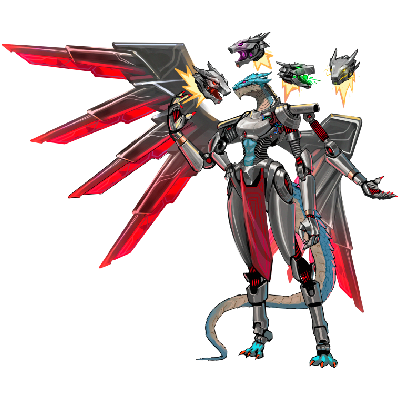
The Draeckocian peoples, also known as Draecks, Dracos, Scalies and 'Gants, are a reptilian species of imposing presence and refined lethality, shaped by a world and culture that rewards capability above all else. At maturity, most Draecks stand between 180 and 220 microunits in height, and around 150 and 180 microunits in weight, commonly exceeding that of many other Federation peoples of similar stature. Their bodies are long and lean, built for reach, leverage, and endurance rather than bulk alone. A long, muscular tail extends behind them, used as much for balance and emphasis as for motion, while their legs terminate in three-toed, taloned feet adapted for grip and stability.
Perhaps their most striking feature is their four arms. Two primary arms sit high on the torso, while a second pair may either share a complex, multi-jointed shoulder assembly or emerge from a lower, independent structure along the body, depending on region of origin on Draeckonis. All four arms end in three-fingered hands tipped with talons, capable of delicate manipulation or devastating force. Their long necks support narrow, predatory snouts lined with multiple rows of sharp teeth, suited for a carnivorous diet. The head is crowned by keen sensory organs: eyes set slightly to the side to grant wide predator vision without significant blind spots, and olfactory structures so sensitive they can detect pheromonal traces, fear, stress, aggression, long before such signals are consciously expressed.
Draeck physiology is a study in accumulated advantage. Their hearing is acute, their vision extends comfortably into low-light conditions, and their sense of smell grants them an intuitive grasp of social dynamics that many mistake for intuition rather than biology. Individually, these traits might seem minor; collectively, they give Draecks a persistent edge that becomes increasingly apparent over time. It is often said within the Federation that Draecks do not dominate through any single overwhelming trait, but through dozens of small ones that never stop adding up.
Their scales are metallic in nature, varying in composition and sheen, and continue to harden as the Draeck ages. Unlike many species, Draecks do not appear to suffer the cellular decline typically associated with age. Their bodies continue to repair and regenerate at a rate comparable to youth for thousands of Marks, and they do not seem to possess a clear maximum lifespan. Indeed, Draecks do not stop growing; size, density, and complexity increase steadily, allowing elder Draecks to rival even the largest Trolls or Oricalcai in sheer physical presence. Whether this potential longevity would ever naturally express itself is unclear, as Draeck society is marked by violent succession and frequent assassination, making death by age a theoretical curiosity rather than an observed outcome. No Draeck has ever submitted themselves to Federation Sci-Techs for study, so it is unclear if they have a natural lifespan or not.
Sexual dimorphism is pronounced. Females are typically larger, more colourful, and more physically imposing, a trait that underpins the strongly matriarchal structure of Draeck society. While power is technically meritocratic, the realities of violent succession and cultural expectation mean that females dominate positions of lasting authority. Draecks reproduce in clutches, but tradition dictates the recognition of a single or pair of heirs, forcing offspring into direct competition. Survival is proof of worth; failure is not tolerated. This process is ruthless and not without its inefficiencies, but it produces individuals of exceptional capability—when it works.
The Draeckocian peoples are intensely proud, fiercely loyal to their empire, and unapologetic about the brutality of their traditions. They claim descent from the primordial dragons, insisting they once possessed wings and elemental breath, though no physical evidence supports this belief. Whether myth, propaganda, or lost truth, the claim endures. What cannot be disputed is this: Draecks obtain a level of competence unheard of by many others, and their society is designed to ensure that only the most competent endure.
Culture
Draeck culture is built at the intersection of pride, competence, and ambition, each reinforcing the other until they become indistinguishable. In their earliest eras, Draeck society was divided into fiercely territorial clans, each vying for dominance through open conflict. This proved catastrophically effective. As an intensely social and highly capable people, the Draecks excelled at coordination, strategy, and execution — traits that, when turned inward, resulted in wars of annihilation fought with alarming efficiency. Recognising that unrestrained conflict threatened their own survival, the Draecks adapted not by abandoning violence, but by formalising it.
From this crucible emerged the great houses and, eventually, the Draeckonian Empire. Power was no longer chaotic, but ordered into an intricate hierarchy that extended from the lowest-ranked Draeck to the Empress herself. Every individual holds a precise position within this structure, understood instinctively and reinforced socially. When two Draecks meet, rank is rarely questioned; it is perceived almost immediately through posture, confidence, bearing, and reputation. To know one’s place is not submission, but clarity. Those who reject the hierarchy outright are considered destabilising forces. Most are killed. The rare few who survive outside it are known as Ronin Draeck — publicly condemned for their irresponsibility but often respected for their strength, feared for their unpredictability.
Life within the hierarchy is a long game of service and succession. Most Draecks spend their extensive lives working under another, honing skills, accruing influence, and watching for failure. Advancement is expected, but not granted; it is taken. Assassination is not inherently criminal within Draeck culture. It is only considered murder if the killer is judged less capable than the victim of fulfilling the role and responsibilities assumed. The underlying assumption is simple: if you remove someone above you, you must become them. Those who cannot perform are swiftly removed in turn. In this way, the hierarchy continuously tests itself, producing leaders who are, at least by Draeck standards, proven.
This system has come under strain since Draeck integration into the Federation, and even more so in the capitalist era. External legal frameworks, corporate liability, and interspecies law have imposed constraints that many Draecks view as corrosive. Where once competence alone determined authority, now contracts, regulations, and courts intervene. While some adapt pragmatically, many resent these changes, watching what they consider a pure meritocracy erode under foreign values.
In their dealings with non-Draecks, Draecks can appear condescending, even dismissive, but this rarely translates into outright hostility. They hold lower expectations of outsiders. for better or worse, and therefore feel less compelled to test them through lethal means. Non-Draecks are frequently employed as bodyguards, specialists, advisors, and assistants, roles valued for their utility rather than their place in the hierarchy. At the same time, it is considered foolish, even shameful, for a Draeck to underestimate other races. Those who endure longest are often the most studious, learning the strengths, customs, and strategies of others, not out of admiration, but to better refine and empower Draeckonian dominance.
Role in the Federation
By the time the Draeckonian Empire encountered the Federation, it was already vast. Positioned along a lower universal plane, where expansion trends favour breadth over ascent, the Empire had spent Epochs conquering neighbouring peoples and absorbing them into its hierarchy. Unlike many later Federation members, the Draecks did not emerge as a young or fractured power, but as a mature imperial force with fleets, doctrine, and cultural continuity already firmly established. Even after joining, they would retain more of their imperial rites and internal autonomy than almost any other member, conceding only where it served Draeckonian interests.
First contact, true to form, was bloody. Initial Draeck engagement with Federation forces followed a familiar pattern: rapid escalation, overwhelming force, and the expectation of swift submission. When resistance proved stronger than anticipated, however, Draeck culture adapted as it always does. The commander responsible was removed, assassinated by their second or ambitious hopeful, and a more diplomatic approach followed immediately. This shift averted what might have been a war catastrophic enough to cripple both the Empire and the Federation. From this moment emerged the Golden Pact: the Federation formally recognised the Draeckonian Empire as a sovereign power; the Empire agreed to contribute a D’jumpship to the Federation; and both parties committed to favourable trade terms and mutual restraint.
The Golden Pact endures into the modern capitalist era. Draeck and Federation trade enjoys unusually low tariffs, lenient enforcement of universal law, and preferential access to markets and transit corridors. While this arrangement has often drawn criticism from other member races, it reflects a pragmatic understanding: the Empire is not easily coerced, and coexistence has proven vastly preferable to confrontation.
Relations between the Draecks and other Federation peoples have been more contentious. Where violence is restricted, conflict often takes the form of contests, economic, political, technological, or personal. It was through these repeated engagements that one truth became impossible to ignore: the Lady of Luck does not favour the Draecks. Against peoples blessed by her hand, Draeck ambition repeatedly faltered at critical moments. Whether this misfortune is the cause or consequence of some ancient transgression remains unknown, though many Draecks believe it is tied to the same lost epoch in which their ancestors supposedly surrendered wings and elemental breath. Attempts to reclaim this lost power continue, though few pursue them openly.
In the absence of divine favour, modern Draecks have turned inward. Wealth, resources, and influence, particularly gold, have become the preferred measures of success. Alliances are entered into cautiously and abandoned without sentiment, viewed as temporary tools rather than bonds. This outlook has led many Draecks to prefer non-Draeck allies, whose loyalty is perceived as less predatory. Some reject the Empire entirely, becoming Ronin in search of autonomy or forgotten truths. Yet whether imperial loyalist or solitary wanderer, every Draeck carries the same underlying belief: power is never given freely, only taken, and kept only so long as one remains strong enough to hold it.
Rules
Below you will find the unique rules and stats you will need to fill out your character sheet.
Stat Block
Mundane Stats
Perceptions
Unique Features
Four Arms
Draecks possess four arms, in two fully independent sets, each governed by a uniquely structured brain with dual major and minor lobes. This pair of minor lobes allows them to perform multiple complex tasks simultaneously with remarkable precision, often treating two separate actions as if each had their full attention. Their heightened sensory awareness further synchronises these movements, enabling seamless coordination or deliberate separation of focus as needed. When brought together on a single task, the result is overwhelming efficiency; even when the hands are not fully aware of one another’s intent, the outcome is almost always superior. To work beside a Draeck is to realise that multitasking, for them, is not a skill, it is instinct.
Trait.
You have four arms. Therefore, you have four Hands, meaning you can Equip up to four Equipment. When you perform the Combat Action, you may use [Weapons] as though you were two separate [Characters] performing a Combat [Action] at the same time, each with the different pair of [Hands] and the same modifiers.
In addition, you gain 2 extra Holsters and an extra [Arm] Cyberware slot.
Furthermore, should you perform a [Check] or [Attack], with an extra sets of [Hands] free and available, you may grant yourself the effects of the Help [Action], as Appropriate.
Please Note: Should you wield a pair of Balanced, [Two-Handed] [Weapons], you may perform 4 Attacks. This is always how it works, these rules are not specific to [Draecks]. Other [Characters] with four arms also perform the [Combat] [Action] in this manner.
Example: If you would perform a [Combat] [Action] with a [Balanced] [Weapon], while wielding another [Balanced] [Weapon], you can perform an Attack with each. Then you would resolve the other [Combat] [Action], with the other pair of [Hands], performing an Attack with the other [Balanced] [Weapon], triggering another Attack with the original [Balanced] [Weapon]. Therefore, performing 4 [Attacks] total.
Pride
Draecks possess an unshakable confidence that borders on arrogance, a certainty in self that rarely falters even under extreme pressure. This pride steels their spirit, leaving little room for doubt, fear, or hesitation — many hexes, compulsions, and morale-breaking effects simply find no weakness to take hold. Spirits can't find purchase on their souls, as their assurity of self repels them. In moments of crisis, a Draeck will act decisively and without second-guessing. Yet this same trait cuts both ways. Pride makes them stubborn, dismissive of counsel, and notoriously difficult to advise. Many Draecks would rather fail alone than succeed with assistance, valuing personal proof over shared victory. Their pride is armour and obstacle alike — powerful, costly, and impossible to set aside.
Trait.
You gain 5 Ego.
In addition, you can never perform a Charm [Ability], nor can you gain any ranks in the [Charm] Mastery or gain any [Charm] [Abilities].
Furthermore, anytime you would receive the benefits of the Help Action or a [Leadership] [Ability], from anyone other than yourself, you trigger Exhaustion.
Growth
Draecks do not diminish with age — they accumulate. As time passes, their bodies grow denser, stronger, and more capable, their movements refining rather than slowing. Their minds deepen in parallel, forming ever more intricate connections between knowledge, experience, and instinct, allowing them to read others with increasing clarity and project whatever presence best serves them. Their metallic scales harden and sharpen, and their frames lengthen and broaden, making them heavier and more conspicuous targets — but also vastly more dangerous ones. Where many races fear the passing of Marks, Draecks embrace it, for like the dragons they claim as progenitors, age is not decline, but ascent.
Trait.
Your mundane Stats cost three [Exp], per rank, to increase, instead of four.
In addition, you gain [Size], Armour and mundane [Stat] [Maximums] as you gain [Job] ranks, as per the following table:
| Job Rank | Bonus Size | Bonus Armour | Bonus Max |
|---|---|---|---|
| 1 | - | - | - |
| 2 | 1 | 1 | 1 |
| 4 | 2 | - | - |
| 6 | 3 | 2 | 2 |
| 8 | 4 | - | - |
| 10 | 5 | 3 | 3 |
Example: Samantha the Salamander, a rank 10 [Draecki] Merc, would be Size: 10, have at least 3 Armour and her mundane [Stat] [Maximums] would be 15. She has rank 8 [Brawn], which is two [Brawn] higher than her [Starter] [Brawn] of 6. For anyone else, this would cost her 12 [Exp] to increase her [Brawn] to rank 9, but because she is a [Draeck], it will cost her 9 [Exp], instead.
Hoarding
All Draecks hoard. It is not a habit so much as a compulsion, woven deep into their sense of self. Power, influence, titles, secrets, art, territory, credits, metals — especially precious metals like gold or platinum — it all ends up gathered, catalogued, and hidden away. A Draeck may recognise the absurdity of it, fully aware that much of what they hoard will never be used, never spent, never even seen again before their death, and yet the instinct remains irresistible. This makes them formidable accumulators of wealth and leverage, always prepared, always resourced — but also prisoners of their own excess, reluctant to part with anything once claimed. Whether it is a lingering curse of the Lady of Luck or the echo of a draconic ancestry, one truth is universally acknowledged: a Draeck never truly owns anything without also being owned by it.
Trait.
Your Upkeep is increased by 500c, for contributions to your hoard. You must always pay this first, before addressing any other [Upkeep].
Additionally, at [Job] ranks 2, 4, 6, 8 & 10, this [Upkeep] increases to 2,500c, 10,000c, 22,500c, 40,000c & 62,500c, respectively.
Please Note: A [Job] rank refers to your [Total] ranks in all of your [Jobs] combined, not just the ranks in a single [Job]. If you have 10 different ranks in 10 different [Jobs], you are [Job] rank 10.