Ability
Ability is a mechanical and categorical term. Abilities are a range of passive and active bonuses, effects, or direct interaction an Entity may utilise to engage with the universe of Meat Space.
When rules refer to an Ability it can be any one of the 3 primary types of Abilities; Action, Ritual or Trait which are listed and described below.
All Characters have a number of Abilities available to them at all times. These General Abilities cover all of the basic interactions and mechanical rules a Player will need to engage with the world of Meat Space.
For the full list and description of these Abilities see General Abilities or scroll below to General Abilities.
Primary Ability Types
Action
Abilities that happen quickly and require an amount of Action or Quick Action Points to use.
Ritual
Abilities that require time to perform, ranging from several Actions up to multiple [Cycles].
Actions
To do anything with your Character in Meat Space consists of taking some kind of Action, these Actions can be broken down into 3 primary types:
The all-purpose action, covers anything that takes a bit of focus, from firing a gun to pointed conversation.
A rapid action, covers anything that can be done in a snap, from snarky replies to quick-drawing a pistol.
Each of these Action types is representative of how quickly any given task or manoeuvre can be accomplished by a Character. Anything that may take many consecutive Actions or a longer time than that is where Rituals come in.
A Character may only perform Actions if they have the required amount of Action Points or Quick Action Points. For further detail on each Action and their costs see below. For general Actions available to all Characters see General Abilities.
See also Spells for magical Actions.
Action
An Action costs 1 Action Point to perform.
Unless otherwise stated, an Action may only be performed during a Character's own Turn.
Double Action
Some Abilities will require 2 Actions Points to perform. These Actions are referred to as Double Actions and follow the same rules as normal Actions with the exception of their Action Point cost.
Quick Action
A Quick Action costs 1 Quick Action Point to perform.
A Quick Action may be performed during your own Turn, during other Character's Turns or while resolving Rolls or effects, as Appropriate.
Free Action
A Free Action costs no Action Points or Quick Action Points to perform.
A Free Action may be performed during your own Turn, during other Character's Turns or while resolving Rolls, as Appropriate. In addition, unless otherwise stated, a Free Action can never provoke a Multitasking Save or trigger Exhaustion.
Ritual
This section is currently in the process of being written - AAXW!
Meat Space is currently in pre-alpha, and this page will be expanded with additional guidance, examples and context during development.
A Ritual a type of Ability. They represent an Entity's cumulative efforts to achieve an outcome over time. They take longer to complete than an Action, but rarely result in Failure. A Ritual is not a matter of Success or Failure, but of time. Specifically, how much? A Ritual is best applied when Success is certain, or extremely likely to occur, but the amount of time required is variable, such as breaking into a safe during a heist or attempting to assume a disguise before being discovered by a patrolling security guard. If Failure is still a meaningful possibility, a Check or Attack is usually more Appropriate.
Rituals are most commonly shown in the format of:
Please Note: Invocations are a type of Ritual, and all rules that apply to Rituals also apply to Invocations. However, some rules apply specifically to Invocations and not to Rituals. If an Ability, Item, etc. specifically mentions Invocations, it only affects Invocations, not Rituals. See Invocations for more information.
To perform a Ritual, an Entity performs an Appropriate Skill Check and records its Total. The Entity continues to perform Skill Checks, limited by the Interval. Add the Total of each Check together. When the combined Total equals or exceeds the Severity of the Ritual, the Ritual is completed Successfully.
To determine the Appropriate Skill for a Ritual, there are two methods. If the Ritual is granted by an Ability, the Ability will specify a Skill. For a custom Ritual, the GM determines which Skill is most Appropriate for the Situation.
The Interval specifies how often the Skill Check can be performed to advance a Ritual. An Entity cannot perform a Check to advance a Ritual more often than the Interval allows, even if they have completed the Ritual. An Action-based Ritual can be advanced repeatedly, Action after Action, while a Round-based Ritual can only be advanced once during each Round during that Entity's Turn. See Interval for more information.
A Ritual's Severity represents how difficult, or how much time, the Ritual will take to complete. The greater the Severity, the more difficult the Ritual. A Ritual is completed Successfully when the combined Total of all Checks equals or exceeds its Severity. See Severity for more information.
If you achieve a Critical Success while performing a Check to advance a Ritual, it is treated the same as any other Critical Success on a Check. Double all non-D20 Bonuses added to the Check when calculating its Total. The subsequent Total is then added to the ongoing Total for the Ritual. However, if you suffer a Critical Failure while performing a Check to advance a Ritual, the Check Fails, producing a Total of 0, and the entire Ritual Fails as well, causing all progress to be lost. This is one of the few ways a Ritual can Fail.
Please Note: Certain Rituals, such as Invocations, may have additional outcomes for Failure in this manner, see their page for more information.
Example: Johnny Tutorial is performing the Set Up - 80 Ritual on his favourite Heavy Sniper Rifle. This is a Tech Ritual with a Severity of 80 and an Action Interval. Johnny gets a +8 and 1D4 to Tech Checks. He spends an Action Point to progress the Ritual with his Tech Check. Johnny gets a Total of 23 from his Dice and Static Bonus, he now has progressed the Ritual 23 out of the 80 Severity needed.
Johnny spends another Action Point, this time he Critically Succeeds on his Check, doubling his Static Bonus and Bonus Die to 16 and 6 respectively. All up, Johnny gains a whopping 42 from that Check, for a total progress of 65 out of 80. With his third and final Action Point Johnny completes the Ritual with a Check Total of 16, for a combined progress of 81, greater than the Severity 80 that is needed. Since the Set Up - 80 requires no additional costs, the Ritual Succeeds and Johnny's Heavy Sniper Rifle is setup and ready to fire.
Severity
Severity is a mechanical term involved in Rituals.
Severity denotes the Total required to achieve Success on a Ritual.
Example: If the famous Merc, Buck Texas, was attempting to perform a Mod installation Ritual on his favourite Flashrifle, that Ritual would have Severity of 80 and an Interval of [Periodic]. Buck would require a combined Total of 80, across all of his Tech Checks.
During the previous Periodic Intervals Buck achieved Totals of 27 and 31, meaning the progress of the Ritual is 58 out of a Severity 80, Buck needs a Total of 22 or more to complete the Ritual during this Interval.
Buck rolls his Tech Check and gets a Total of 24, which is added to his progress for a Total of 82. Since 82 is greater than the Severity of 80, the Ritual is Successful and Buck installs the Mod in his Flashrifle with no issue.
Interval
Interval is a mechanical term involved in Rituals.
An Interval denotes the Action speed at which you can perform Checks to progress a Ritual.
Example: If Johnny Tutorial was attempting to perform the Setup - 80 Ritual on his favourite Heavy Sniper Rifle, that Ritual has an Interval of Action. Johnny could only perform a Skill Check any time he could perform an Action, each one costing him an AP.
Traits
Traits are passive Abilities commonly gained through Races, Jobs, Masteries, or conveyed through Equipped Items.
Traits are always active or active for a specified Time and affect the Entity they appear on such as Characters and Vehicles.
See below a list of all available Traits.
General Abilities
General Abilities are a category of Ability. They are common Abilities that all Characters can use. These Abilities should facilitate any action a Character may wish to perform
When reading an Ability, they use the following format:
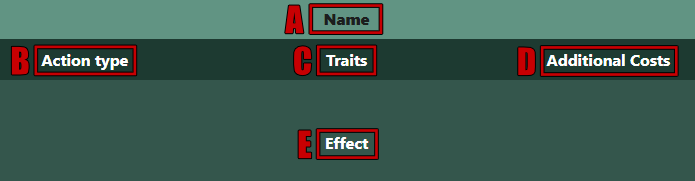
The following is the full list of General Abilities available, sorted by their broad usage.