This is an old revision of the document!
Elf
| Attributes | ||
|---|---|---|
 |
||
| Avg Life Span | 2000 - 3000 [Marks] | |
| Sexual Dimorphism | No | |
| Sexes | Male/Female | |
| Physiology | Organic | |
| Average Height | 150 - 215cm | |
| Average Weight | 55 - 70kgs | |
| Home System/Planet | Celestia System, Avalon | |
Elves, also known as Pointies, Twigs, Dreamers and Hollowbones, carry age as a presence rather than a mark. There is nothing visibly ancient about their bodies, yet every elf bears a sense of continuity, an inherited awareness shaped by countless lives before their own. This manifests as composure, confidence, and an unshakable familiarity with the universe, perceived by outsiders as wisdom or arrogance depending on context. As the earliest starfaring people, elves move with the ease of those who have never considered the unknown to be frightening, only unexplored.
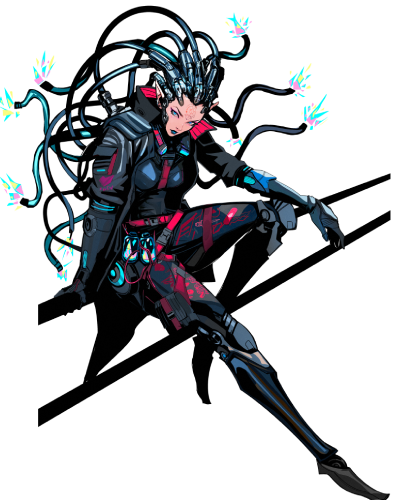
Physically, elves are slight and remarkably light, their frames shaped by hollow skeletal structures that reflect a shared ancestry with avian fauna and fae spirits from their homeworld of Avalon. Height varies widely, typically ranging from 150 to 215 centimeters, yet mass remains consistently low, usually between 55 and 75 kilograms. Their bodies favour length over density, with narrow torsos and elongated limbs that give them a floating quality in motion. Even at rest, elves appear poised, as if balance and readiness are their natural state rather than a learned posture.
Elven skin tones are uniformly subdued, as though filtered through mist or ash. Colours span pale tans, soft browns, and desaturated creams, with rarer hues of green, blue, and violet, never vivid, never stark. These tones echo the environments of Avalon: the muted whites and yellows of stone and bark, the softened greens and oranges of foliage, and the quiet blues and purples of shaded blooms. In contrast, elven hair is strikingly vivid and confined exclusively to the scalp. It grows long and straight, often standing or flowing like plumage, and appears in brilliant, saturated colours across the full spectrum. Their eyes are perhaps their most arresting feature: with mineral-bright and crystalline structures under the cornea, refracting light through gem-like structures that cause them to sparkle in shades reminiscent of jade, sapphire, garnet, onyx, and other precious stones, in all manner of colours. With the widespread adoption of Aestheskin Cyberware, many elves alter their appearance repeatedly over their long lives, treating form as another evolving expression rather than a fixed identity.
Elves possess two biological sexes, male and female, though sexual dimorphism is minimal, almost non-existent, and gender expression is culturally fluid. Facial hair is absent aside from fine eyebrows, and body hair does not develop beyond the scalp. Their features are soft yet sharply defined, with pronounced cheek structures and long, elegantly tapered ears characteristic of fae-descended peoples throughout the Federation. Elven bodies tend toward gentle curves without pronounced musculature, emphasizing flexibility and speed over strength. Longer limbs and compact torsos allow for rapid movement and thought, often appearing nearly instantaneous to other species. Communication for elves is rarely limited to speech alone; words are accompanied by gesture, posture, rhythm, and sometimes full-body movement. To watch an elf speak is to witness language made physical, an ongoing dance of intent, meaning, and motion.
Culture
Elven culture is shaped by duration. As a long-lived and intensely persistent people, elves experience history not as a sequence of eras but as a continuous present, watching entire civilizations rise, fracture, and fade within a single lifetime. This has fostered a tendency toward singular focus: an elf may devote Ages to perfecting a single craft, philosophy, invention, or art form, refining it through iteration rather than reinvention. As a result, elves often perceive other species as impulsive or impatient, quick to act where restraint might yield better outcomes. This disposition frequently places them in the role of mediators, archivists, and voices of caution, though their advice is not always welcomed.
Despite this patience, elves are not aloof. They are deeply social beings, motivated strongly by connection and emotional understanding. While they are capable of spending long cycles, or even many Marks — in solitude, such isolation is usually purposeful rather than withdrawn. Elves invest significant effort in listening to others, learning their motivations, fears, and joys, and adjusting themselves accordingly. Lacking the biological need for sleep, they can become intensely immersed in social or intellectual pursuits, sustaining conversations, projects, or collaborations for extraordinary lengths of time without pause. To outsiders, this intensity can feel overwhelming, even invasive, though it is rarely intended as such.
The most consequential event in elven cultural memory is their first venture into the stars. Guided by long association with astral spirits, the elves believed that leaving Avalon would lead them to kindred beings beyond their world. This journey brought them instead to a vast water planet they named Atlantis, home to numerous aquatic sapient peoples later known collectively as the Atlanteans. Encountering these societies in early, fragmented states, the elves assumed the role of mentors, providing powerful technological and arcane tools intended to lift the Atlanteans beyond planetary constraint. The elves believed that expanded space and shared prosperity would dissolve internal conflict.
This belief proved catastrophically wrong. Atlantean societies turned the gifted power inward, waging wars of unprecedented scale and devastation. Confronted with the consequences of their intervention, the elves reclaimed their technology and enacted a powerful magical erasure, removing all memory of their presence from Atlantean history. They withdrew, burdened by regret, and resolved never again to impose guidance without consent. Many Epochs later, when the Atlanteans themselves reached the stars aboard the first D’jumpship, the Argo, it was they who came to Avalon—this time to rescue the elves from a crisis of their own making. Together, these two peoples laid the foundations of the Federation and codified the First Contact Protocols, intended to prevent such tragedies from repeating.
In the present era, elves remain among the most vigilant protectors of emerging species. Though the Federation has shifted toward capitalist values that strain older ideals, elves remember the cost of unrestrained intervention. They are often the first to invoke First Contact Protocols, to challenge corporations or governments that violate them, and to remind the wider Federation that patience and restraint are not weaknesses. To elves, history is not distant, it is personal, and they refuse to allow others to repeat mistakes they themselves still carry.
Role in the Federation
The Federation began as an elven idea made real through shared failure and mutual trust. When the Atlanteans — by then a multi-species civilization shaped by many cultures, formed a council to govern their expanding society, the elves recognized a structure capable of avoiding the mistakes of their past. Rather than rule, they chose representation, elevating members of their great families to sit alongside Atlantean delegates. From this union emerged what would become known as the Federation of Sapient Races, founded not on conquest or ideology, but on restraint, cooperation, and the promise of shared responsibility.
To stand as equals, the elves matched the Atlanteans’ greatest achievement. While the Argo would become known as the first true D’jumpship, the elven response took the form of a similarly immense vessel, vast, self-sustaining vessels large enough to function as artificial worlds. These vessels, built before the formalization of D’jump theory, were known as Homeships. These ships served as mobile centers of culture, diplomacy, and exploration. Together, these Homeships carried resources between Avalon and Atlantis, charted unknown regions of space, and sought out other sapient peoples. Their mandate was clear: protect emerging civilizations from existential threats and welcome those ready to stand among equals.
From those beginnings, elves and Atlanteans have been present at nearly every turning point in Federation history, with the elves prioritising spirituality and morality while the Atlanteans prioritising practicality and needs. Their combined influence is rarely singular or overt, but it is persistent. In the recent era, many elven ruling houses gradually privatized, eventually consolidating into the giga-corporation Elysian Greens. Though this shift altered the shape of their authority, it did not diminish it. Elven interests remain deeply embedded across political, cultural, and economic spheres, and their long memory allows them to manoeuvre patiently where others act quickly.
Relations with most Federation members have remained strong, built on diplomacy and careful listening. The most notable exception is the long-standing rivalry with the Dwarven peoples and their modern corporate incarnation, the Vigilance Mining Guild. Both sides are renowned for producing some of the finest technology, infrastructure, and materials in known space, and competition between them — once cultural, now corporate, has occasionally escalated beyond friendly comparison. Even so, this rivalry has rarely crossed into open hostility, constrained by mutual respect and a shared understanding of consequence.
Today, elven embassies can be found on nearly every Federation world. Elves devote entire Epochs to observing, cataloguing, and understanding the countless peoples of the three known Spaces, digital, astral and mundane alike. Whether acting openly as diplomats or quietly as observers, they are almost always present where history is being written. For many within the Federation, the elves are not simply founders, but custodians, watchful, patient, and determined that the galaxy not forget the lessons they learned the hard way.
Rules
Below you will find the unique rules and stats you will need to fill out your character sheet.
Stat Block
Mundane Stats
Perceptions
Unique Features
Aeonic Mindset
Elves think on the scale of Ages. Their decisions are shaped by the expectation of living long enough to see outcomes fully unfold, and this grants them a way of thinking that prizes correctness over speed. An elf observes first, studies second, plans third, and practices until error has been ground away entirely. Action is delayed not by indecision, but by patience, by the certainty that rushing only creates work that must later be undone. When an elf finally commits, the result is often flawless, executed with a precision born of repetition and foresight rather than inspiration. To shorter-lived peoples this mindset can appear slow, aloof, or infuriatingly cautious, but to elves it is simply the natural consequence of knowing they will still be here when everyone else is gone, plus, it is hard to argue with the results.
Trait.
You gain the effects of the Advantage Property, Upgrading when performing Checks to advance any Ritual, including Invocations.
However, the number of Projects you can maintain is reduced by 1, to a minimum of 1.
Silence! I’m trying to think!
Elven cognition is powerful, and fast, but not susceptible to rapid change. Their minds are built for depth, not immediacy, and sudden change disrupts them more than it does most species. When situations evolve rapidly, plans fracture, or interruptions break concentration — especially during complex rituals or precise work, elves struggle to reorient. Momentum lost is difficult to regain, and improvisation rarely comes naturally. Where others push through chaos on instinct, elves must first restore internal order, often at great cost. In calm conditions this flaw is invisible; in crisis, it can be decisive.
Trait.
You suffer the effects of the Disadvantage Property, Upgrading or Downgrading Properties when performing any Multitasking Saves.
Dreamwaker
Elves do not sleep, because they do not need to leave the waking world to touch the astral. Where most beings rely on dreams to flush mana through the body, restoring mind, soul, and form, elves remain continuously connected, their awareness threaded directly into the living currents of magic. They pause only to centre themselves, never to rest. Subtly sustained by light and environment, they can work, study, create, and cast without the cycles of exhaustion that bind other races. Spent mana returns to them with unnatural speed, allowing sustained and repeated spellwork where others would falter or collapse. Though their bodies heal more slowly than some, this is a trivial cost for a people who never truly power down. Elves are awake when others dream, present when others recover, and dangerous precisely because their magic does not wait for permission to return.
Trait.
You do not require sleep and thus you suffer any ill effects for staying awake for long periods of time. You will also not restore Health or heal Injuries when you Rest.
In addition, you restore Mana equal to your Hokum at the end of each Encounter instead of each Scene. At end of each Scene, you will restore 1 missing Health. If your Health is full, you will reduce the Severity of your oldest Injury by 1.
Ash's Aside
It is reasonable to assume that you may be able to perform tasks, as Appropriate, while others perform Rests, but it is important to understand that Elves do like to take time to meditate and think on recent events, so it is important to role play such activities as well. However, there is nothing wrong with asking the Character who doesn't sleep to go on watch.